

Table of Contents
- What Makes a DTF Transfer Professional Grade
- DTF Transfers vs Screen Printing Pros: Where Each Method Wins
- How to Test DTF Transfer Durability Before You Sell
- Common DTF Transfer Defects to Avoid
- What Professional Grade DTF Transfer Quality Costs Per Unit
- Storage, Shelf Life, and the Certifications Worth Asking About
- Frequently Asked Questions
Last Updated: September 16, 2026
What Makes a DTF Transfer Professional Grade
Professional grade DTF transfer quality comes down to one thing: how well the ink bonds to the film and how well that film bonds to fabric. Everything else is marketing. A direct-to-film transfer is a printed design on a PET film carrier, coated with a hot-melt adhesive powder that activates under heat and pressure. When that powder layer is applied evenly and cured properly, the transfer survives repeated washing.
The Four Quality Signals That Actually Matter
Four signals separate professional grade DTF transfer quality from hobbyist output:
- Ink adhesion: The cured ink layer should resist scratching with a fingernail after pressing. If it flakes, the curing process was incomplete.
- Color vibrancy: A proper white ink layer under the CMYK color space produces opaque, saturated color on dark garments. Thin white layers look washed out.
- Print resolution: Fine details, small text, and gradients should hold their edges without bleeding or banding.
- Stretch resistance: The transfer should flex with the garment without cracking along fold lines.
DTF Transfers vs Screen Printing Pros: Where Each Method Wins
DTF transfers win on short runs, complex full-color artwork, and no-weeding production. Screen printing wins on high-volume single-color jobs and bulk pricing at scale.
| Factor | DTF Transfers | Screen Printing |
|---|---|---|
| Setup cost | Low, no screens | High, one screen per color |
| Best for | Short runs, full-color art | Bulk single-color jobs |
| Fabric compatibility | Cotton, polyester, blends | Mostly cotton |
| Detail level | Fine gradients and text | Limited by screen count |
| Minimum order | One piece | Often dozens |
How to Test DTF Transfer Durability Before You Sell
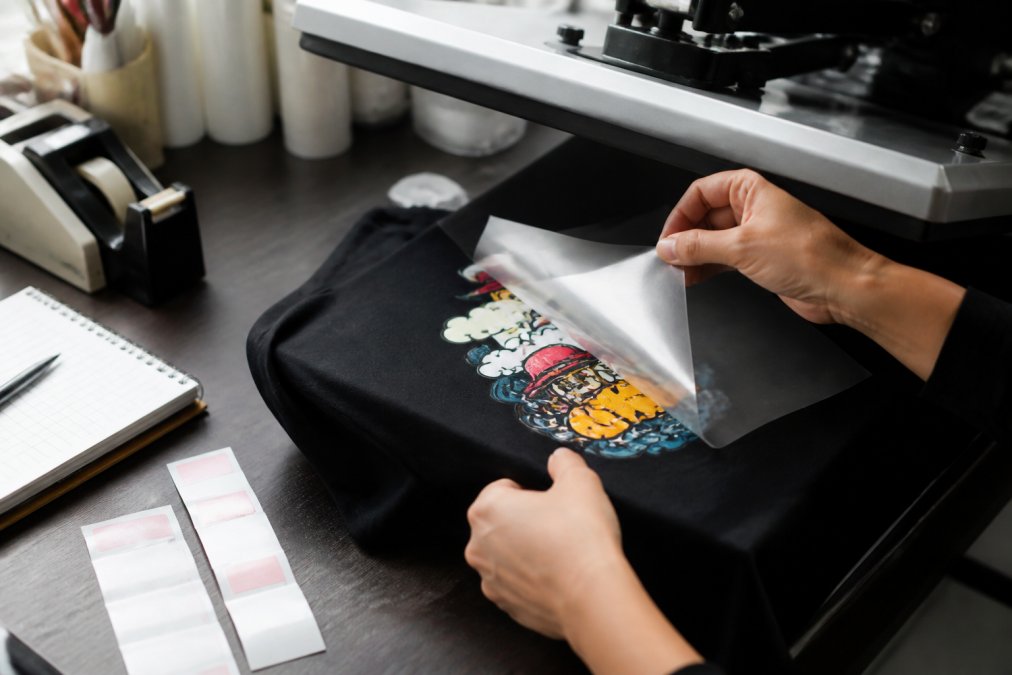
Most DTF guides tell you to "wash it and see." That is not a test, it is a guess. Professional buyers need a repeatable protocol with pass/fail thresholds, because the difference between a transfer that survives 30 washes and one that fails at wash four is invisible until a customer complains.
Build a Standardized Wash-Test Protocol
The American Association of Textile Chemists and Colorists (AATCC) publishes the reference methods the apparel industry uses for colorfastness and durability, AATCC 61 for accelerated laundering and AATCC 135 for home-laundry dimensional change. You do not need a lab to borrow their logic. You need consistent variables and a scoring sheet.
- Press three identical samples onto the fabric blend you sell most (for example, 100% cotton and a 50/50 cotton-poly blend). Pressing three, not one, catches batch variation inside a single order.
- Label each garment with the date, press temperature, dwell time, pressure setting, and peel method (hot vs. cold).
- Wash inside-out in cold water with a mild liquid detergent and no fabric softener. Softener leaves a residue that masks adhesion failures.
- Tumble dry low or hang dry, matching the care label you ship with the garment.
- Inspect after washes 1, 3, 5, 10, and 20. Real failures cluster at two points: wash one (under-activated powder) and washes three to five (weak thermal bonding).
- Score each inspection on a 1-5 scale for edge lifting, cracking along fold lines, color fading, and hand-feel stiffness. Log the score, not just a yes/no.
Pass/Fail Thresholds That Mean Something
A transfer is professional grade if it holds a score of 4 or better through 20 wash cycles on the fabric blend you tested. Anything that drops below 4 by wash five is a hobbyist-grade product, regardless of how it looked out of the press.
Watch for these specific failure signatures:
- Edge lifting within the first wash points to under-activated adhesive powder, the press was too cool, the dwell too short, or the powder coat was uneven.
- Cracking between washes three and five points to brittle ink from over-curing or a film with poor elongation.
- Progressive color fade across all cycles points to low pigment load or a thin white underlayer, not a wash problem.
- Stiffening hand-feel points to excess powder that fully melted into the fabric rather than forming a thin adhesive layer.
Compare Suppliers With the Same Protocol
The real value of a standardized test is comparison. Run the same protocol on transfers from two or three suppliers, using the same fabric, the same detergent, and the same dryer setting. Most sellers find that the cheapest per-unit transfer is rarely the cheapest per-wear, a $1.50 transfer that fails at wash four costs more in replacements and reputation than a $2.25 transfer that holds through 30 cycles.
Common DTF Transfer Defects to Avoid
The most common DTF transfer defects trace back to three causes: uneven powder application, wrong heat-press settings, and poor substrate adhesion. Each one produces a different failure pattern.
Pressing too cool or too briefly leaves the adhesive powder under-activated. The transfer looks fine out of the press, then peels at the first wash. Always verify your press temperature with a heat gun before a production run.
Watch for these defects:
- Orange peeling: The film lifts while still warm, usually from hot-peel timing errors.
- Cracking: Brittle ink from under-curing or excessive heat.
- Dull color: Insufficient white ink layer or low print density.
- Edge lifting: Weak powder coverage around the design border.
What Professional Grade DTF Transfer Quality Costs Per Unit
Per-unit cost for ready-to-press DTF transfers depends on design size, order volume, and whether you're buying transfer-only or fully pressed apparel. At Creations With Purpose, an 11-inch ready-to-press transfer such as the 11" DTF Ready to Press - I Gotta See the Candy First runs $1.75, and you can add a Gildan Heavy Blend garment with our pressing service if you'd rather skip the heat press entirely.

Storage, Shelf Life, and the Certifications Worth Asking About
Storage is the most under-discussed variable in DTF quality, and it is the one that quietly destroys transfers before they ever reach a press. The adhesive powder layer is hygroscopic, it absorbs moisture from the air. Once the powder takes on water, it no longer melts into a clean film under heat; it foams, cures unevenly, and bonds weakly. A transfer that was perfect on arrival can fail at wash one purely because it sat in a humid garage for three months.
How Shelf Life Actually Breaks Down
Most manufacturers quote a shelf life in the range of six to twelve months for unopened, properly stored transfers, and shorter once the bag is opened and the film is exposed to ambient air. Treat those numbers as ceilings, not guarantees, heat, humidity, and UV light each shorten the window independently.
The three degradation mechanisms to know:
- Moisture absorption softens the powder layer and causes foaming or incomplete melt during pressing.
- Heat exposure (above roughly 80°F in storage) can partially activate the powder prematurely, so it no longer flows correctly when you press.
- UV light degrades the ink pigments themselves, causing color shift long before the adhesive fails.
Storage Rules That Preserve Quality
Store transfers flat, never rolled or folded, because creases in the film create thin spots in the powder coat that fail first. Keep them in a cool, dry space away from windows, exterior walls, and any heat source. A sealed bag or gasketed bin with a desiccant packet slows moisture uptake significantly. If you buy in bulk, rotate stock first-in, first-out so older transfers get pressed before newer ones.
If a transfer has been stored in a humid space, press a test sample before running a customer order. A quick press on scrap fabric will reveal foaming or weak adhesion in under a minute, far cheaper than discovering it on a paid job.
Certifications Worth Asking Your Supplier About
Professional buyers, especially anyone selling into schools, children's apparel, or healthcare-adjacent markets, should ask suppliers directly about two certification families:
- OEKO-TEX Standard 100 covers textile articles tested for harmful substances. It is the most widely recognized consumer-safety certification in the apparel supply chain, and suppliers who hold it can usually produce a certificate number you can verify.
- CPSIA compliance matters for any product marketed to children 12 and under. The Consumer Product Safety Commission enforces limits on lead, phthalates, and other restricted substances in children's products, and the Consumer Product Safety Commission guidance on textile safety outlines the general expectations. A supplier who cannot speak to their ink and powder chemistry is a supplier who has not asked their own upstream vendors.
The Supplier Questions That Separate Pros From Resellers
When evaluating any DTF supplier, ask these directly and listen for specific answers rather than reassurances:
- What is the stated shelf life, and does it change once the bag is opened?
- What storage temperature and humidity range do you recommend?
- Who manufactures the ink and the adhesive powder, and can you share a safety data sheet?
- Do you hold OEKO-TEX or CPSIA documentation, and can you provide certificate numbers?
- How do you verify batch consistency across reorders, do you retain samples?
- Do you run your own wash-durability testing, and will you share the protocol?
Frequently Asked Questions
What are the visual indicators of professional grade DTF transfers?
Look at three things before you press. First, the white ink layer should be opaque and even, with no thin patches that let garment color bleed through. Second, the print should feel smooth and flexible, not stiff or plasticky. Third, edges should be clean with no stray powder granules clinging to the film. A transfer priced at $1.75 that passes all three checks usually outperforms cheaper stock that looks fine in photos but cracks after five washes.
Why do some DTF transfers crack after washing?
Cracking almost always traces back to one of two causes: incomplete curing during the powder application stage, or a heat press that never reached the right temperature and pressure. If the adhesive powder did not fully melt into the ink, the print has no stretch and splits along the design's stress lines. Wash temperature matters too. Hot water and high-heat dryer cycles accelerate the failure. A proper press at the manufacturer's recommended settings plus cold-water washing extends garment longevity considerably.
How does DTF transfer quality compare to traditional screen printing?
Screen printing wins on cost per piece at high volumes and on stretch resistance for athletic wear. DTF wins on color depth, no minimum order quantity, and the ability to print full-color artwork without setup fees or color separations. For small businesses testing new designs, DTF transfers at $1.75 each let you sell one shirt without committing to a 50-piece screen print run. The tradeoff is that DTF needs correct heat-press settings and a proper curing process to match screen printing's wash-fastness.
How can you test the stretch and durability of a DTF transfer?
Press the transfer onto a scrap of the same fabric you plan to sell, then run a standardized wash test: five cycles at cold temperature, tumble dry low. After each cycle, check for edge lifting, color fading, and cracking. Then grab the fabric on either side of the print and pull. A professional grade transfer stretches with the garment and returns to shape. One that tears or separates from the fabric at the edges will not survive customer use.
The hardest part of selling custom apparel isn't the design; it's trusting that the transfer will hold up after your customer's tenth wash. Creations With Purpose presses and ships ready-to-press DTF transfers built for exactly that kind of repeat wear, with vibrant full-color artwork, designs suited to cotton, polyester, and blends, and quick shipping on ready-to-ship items. Get started with Creations With Purpose and put a transfer on a shirt this week that you'd be confident selling.