

Table of Contents
- DTF Transfers vs Screen Printing: Which One Fits Your Shop?
- Quick Comparison: DTF Transfers vs Screen Printing
- Cost Comparison DTF vs Screen Printing: Batches and Setup Fees
- DTF Transfer Durability vs Screen Print: What Survives 50 Washes?
- Design Freedom and Color: Gradients, Photos, and Fine Lines
- Hand Feel and Fabric Compatibility: Soft Prints vs. Heavy Layers
- Screen Print Transfer Minimums and Order Flexibility
- Which Method Wins for Your Business Model?
- Frequently Asked Questions
Last Updated: September 9, 2026
DTF Transfers vs Screen Printing: Which One Fits Your Shop?
Choosing between DTF transfers and screen printing comes down to one question: how many shirts do you need, and how detailed do the designs need to be? The pros of DTF transfers vs screen printing pros hinge on production volume, setup complexity, and the tactile quality of the final print. At Creations With Purpose, our DTF transfer collection is built for makers who need vibrant, professional-grade designs ready to press without a production floor behind them.
For small batch orders under 24 pieces, DTF transfers deliver full-color results with no setup fees and no minimum order quantity. Screen printing, by contrast, rewards bulk production where the per-piece cost drops dramatically once screens are burned. The real decision point is your order volume and how often your designs change.
Below, we'll break down the cost math, wash durability, design freedom, and hand feel so you can match the method to your actual production workflow.
Quick Comparison: DTF Transfers vs Screen Printing
DTF transfers are a garment decoration method where full-color designs are printed onto a film, coated with adhesive powder, and heat-pressed onto fabric. Screen printing pushes plastisol ink through a mesh stencil, one color layer at a time, to build the graphic directly on the garment.
| Factor | DTF Transfers | Screen Printing |
|---|---|---|
| Setup costs | None per design | Screen burning fees |
| Minimum order | Low, flexible | Often 12-24+ pieces |
| Color complexity | Full-color, gradients | Per-color screens needed |
| Hand feel | Soft, thin layer | Heavier ink deposit |
| Wash durability | Strong with proper cure | Excellent, industry standard |
| Turnaround | Fast, on-demand | Slower, batch-oriented |
The quick verdict: DTF wins for small batches and photorealistic detail. Screen printing wins for large runs where cost-per-print and proven longevity matter most.
Cost Comparison DTF vs Screen Printing: Batches and Setup Fees
The cost comparison DTF vs screen printing changes completely depending on your batch size. Screen printing carries an upfront setup cost because each color in a design requires a separate screen burned with your artwork. A typical commercial screen printer charges a setup fee between $15 and $40 per screen, depending on the shop and the complexity of the artwork. Print a single-color logo in a run of 100 shirts, and that setup cost spreads thin across the order. Print ten different designs in quantities of five each, and the setup fees multiply while the volume stays small.
DTF transfers shift the economics toward flexibility. There are no screens to burn and no setup fees per design, which makes short runs and design variety practical. The trade-off appears at scale: bulk screen printing typically produces a lower cost-per-print once you exceed a few dozen identical shirts, because the ink and labor per unit drop substantially.
To make this concrete, consider a common scenario: a shop ordering 50 white t-shirts with a single-color logo. A screen printer might quote $1.50 per shirt plus a $25 setup fee, bringing the total to $100, or $2.00 per shirt. A DTF transfer supplier might quote $3.50 per transfer, bringing the total to $175, or $3.50 per shirt. The screen printing route wins by a wide margin on this order.
Now flip the scenario: the same shop needs 10 shirts each of 5 different full-color designs. Screen printing requires 5 separate setups, each with multiple screens for the color layers. If each design has 4 colors, that is 20 screens at $25 each, or $500 in setup fees alone, before a single shirt is printed. DTF transfers require no setup, and at $4.00 per transfer, the total for 50 shirts is $200. The DTF cost structure avoids paying for setup work that never gets reused.
The real decision point is your order volume and how often your designs change. For shops doing on-demand fulfillment or frequent design changes, the DTF cost structure avoids paying for setup work that never gets reused. For shops running the same designs in bulk week after week, screen printing's amortized setup cost becomes the clear economic winner. A common pattern among hybrid shops is to use DTF for orders under 24 pieces and screen printing for orders above that threshold, letting each method carry the volume where its cost structure is strongest.
DTF Transfer Durability vs Screen Print: What Survives 50 Washes?
When comparing DTF transfer durability vs screen print, the honest answer is that both can survive 50 washes, but the failure modes differ. Screen printing embeds plastisol ink into the fabric fibers, creating a bond that is famously resistant to cracking and peeling when cured at the right temperature and dwell time. This is why screen printing remains the benchmark for workwear and uniforms that face heavy laundering.
DTF transfers rely on an adhesive powder layer that fuses to the garment during the heat press process. Properly pressed DTF prints hold up well through repeated washing, but the margin for error is narrower. A low press temperature, short dwell time, or incorrect pressure can leave the adhesive under-cured, which leads to edge peeling within a few wash cycles. The fix is consistency: follow the manufacturer's heat press settings exactly, use a quality transfer film, and wash garments inside out in cold water to extend the print life.
Design Freedom and Color: Gradients, Photos, and Fine Lines
Screen printing struggles with gradients and photorealistic images because each tonal shift requires either a separate screen or a halftone dot pattern that simulates shading. Fine line work below a certain stroke weight also becomes difficult, since the mesh screen and ink viscosity limit how crisp a detail can reproduce. Solid spot colors in bold, graphic layouts remain screen printing's home turf.
DTF transfers handle the full spectrum of digital artwork without compromise. Because the design is printed like a document rather than pushed through mesh, you can reproduce raster images, vector art with hairline strokes, and smooth color transitions with photographic accuracy. This makes DTF the clear pick for all-over prints, photo-based graphics, and designs with dozens of colors that would require an impractical number of screens. The print opacity stays high on dark garments, though a white underbase layer is still recommended for maximum vibrancy on black or navy fabric.
Hand Feel and Fabric Compatibility: Soft Prints vs. Heavy Layers
Run your hand across a screen-printed shirt and you will feel the ink deposit. Heavy layers of plastisol ink create a noticeable texture, especially on large block designs or prints with a thick white underbase. Many printers soften this by using thinner mesh counts or water-based inks, but the tactile result still sits on top of the fabric. DTF transfers produce a noticeably softer hand feel because the printed film layer is thin and flexible once pressed. The design moves with the fabric rather than sitting stiffly on top of it. This matters most for comfort-focused garments like performance wear or baby clothes.
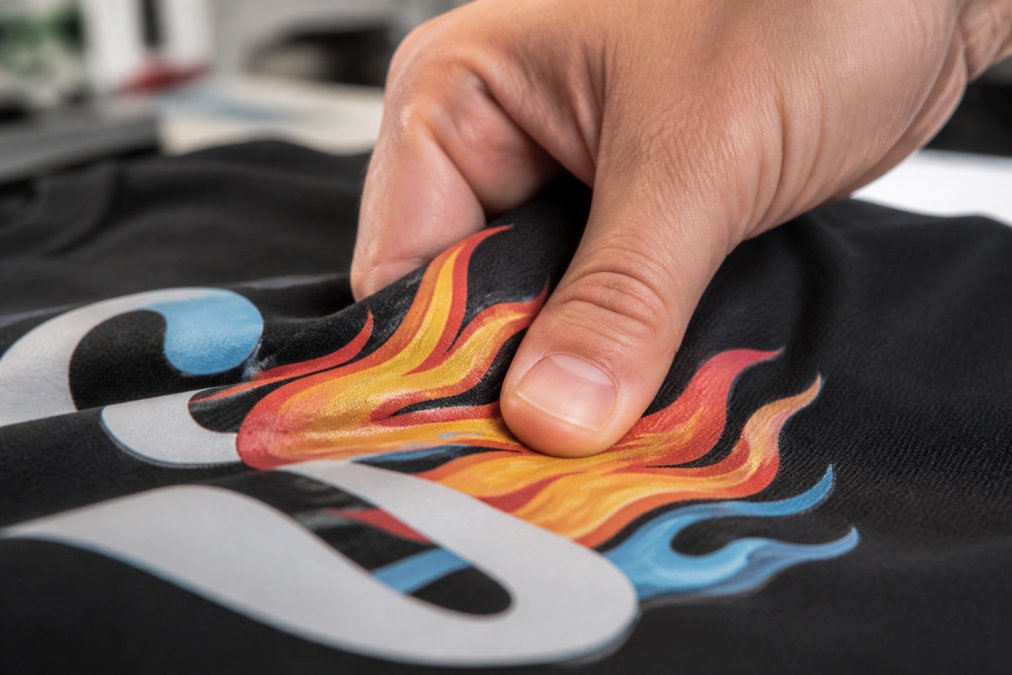
Both methods work on cotton and cotton-poly blends, but DTF transfers also adhere well to nylon, polyester, and blends where plastisol ink can struggle to bond without special additives. Screen printing remains the safer choice for heavily textured fabrics where a smooth transfer film may not fully contour to the surface.
Beyond the tactile feel, there is a growing consideration that most commercial guides overlook: the chemical and environmental footprint of each method. Plastisol screen printing inks are PVC-based. PVC production and incineration release dioxins, which are persistent environmental pollutants (the EPA). Many commercial screen printers have moved to phthalate-free plastisol formulations in response to consumer pressure and state-level regulations like those in California under Proposition 65, which requires warnings on products containing certain chemicals (oehha.ca.gov). However, the standard plastisol ink still carries a heavier environmental load than digital alternatives.
DTF printing uses water-based or eco-solvent inks that do not rely on PVC. The adhesive powder used in DTF transfers is typically a thermoplastic polyurethane (TPU), which is free of the plasticizers found in plastisol. This makes DTF a more straightforward choice for brands marketing to eco-conscious consumers or selling into markets with strict chemical compliance requirements, such as children's apparel sold in California or the European Union. For a growing segment of buyers, the question is not just how the print feels but what is in it.
A practical note on fabric compatibility: DTF transfers perform exceptionally well on synthetic blends like polyester/spandex, which are common in athletic wear. Plastisol ink on high-polyester fabrics requires a low-bleed additive to prevent dye migration, where the garment's dye bleeds into the ink during curing and discolors the print (roq.us). DTF transfers, because they are pressed at a lower temperature and for a shorter dwell time than screen printing cures, are less prone to this issue. This makes DTF a strong candidate for performance apparel, where the softer hand feel and reduced dye migration risk are both tangible benefits.
Screen Print Transfer Minimums and Order Flexibility
Screen print transfer minimums are a practical barrier for small shops. Because the setup cost is real, most commercial printers require a minimum order quantity to make the job worthwhile. If you need twelve shirts in six different designs, you will either pay for six separate setups or find a printer willing to eat the cost for a larger total order.
DTF transfers remove the screen print transfer minimums constraint entirely. You can order a single transfer or a handful of prints for a one-off order, a sample, or a custom piece for a live sale. This flexibility supports test runs before committing to larger inventory. For makers who sell at markets or through live shows, the ability to produce small batches of new designs without financial risk is a decisive advantage. The trade-off is that per-unit costs stay flat, so you will not see the volume discounts that bulk screen printing offers.
Which Method Wins for Your Business Model?
Match the method to your production reality rather than chasing a universal winner. Screen printing is the right call for established shops running consistent, high-volume orders of the same designs, especially single-color or limited-palette graphics where the setup cost amortizes across hundreds of units. The durability and low cost-per-print at scale are unmatched.
DTF transfers suit businesses that thrive on variety and speed. If your catalog changes weekly, you sell through live events, or you fulfill one-off custom orders, the absence of setup fees and minimums makes DTF the more profitable route. The softer hand feel and full-color capability also give you a product advantage on premium garments. At Creations With Purpose, our DTF transfer collection is built for makers who need vibrant, professional-grade designs ready to press without a production floor behind them. SHOP to see how full-wrap artwork and exclusive designs can differentiate your next drop.
Frequently Asked Questions
Which lasts longer, DTF or screen printing?
Screen printing generally has the edge for extreme longevity, often lasting 50-plus washes with minimal fading when cured correctly with plastisol ink. DTF transfers, when pressed with the right temperature, pressure, and dwell time, also hold up well, though heavy layers can crack over time. The adhesive powder quality and washing method matter. For garments that see heavy industrial laundering, screen printing wins. For typical consumer care, both methods deliver strong results.
Is DTF more cost-effective for small batch orders?
Yes. DTF transfers have no setup costs or screen mesh charges, making them ideal for one-off prints and small batches. Screen printing requires creating screens per color, which is only economical at higher quantities. If you need 10 shirts with a full-color design, DTF is clearly cheaper. As order volume climbs into the hundreds per design, screen printing's lower cost-per-print takes over.
Can DTF transfers match the soft hand feel of screen printing?
Not exactly. A well-pressed DTF transfer has a noticeable but flexible feel, often described as slightly rubbery. Screen printing with a thin ink deposit can feel softer, especially with water-based inks. However, DTF has improved significantly. Using a low-bleed film and a quality adhesive powder creates a thinner layer that drapes better on fabric. For most wearers, the difference is minor after the first wash.
What are the disadvantages of DTF transfers?
The main drawbacks include a slightly thicker hand feel compared to screen printing, a slower per-piece process when pressing transfers, and a white border or 'halo' if the adhesive powder is not applied correctly. DTF prints can also crack if pressed with too high a temperature or if the garment is over-dried. Finally, sourcing consistent, high-quality transfers from suppliers is critical; quality varies widely.
The choice between DTF transfers and screen printing is ultimately a volume decision dressed up as a quality debate. Screen printing rewards repetition; DTF rewards flexibility. For small-batch creators, live sellers, and anyone testing new designs, DTF transfers deliver full-color results without the setup overhead or minimum order requirements. Get started with Creations With Purpose and bring your most detailed designs to life on your next order.